How to Write a Corporate Travel Policy for Your South African Business
The single most effective document your company can implement to reduce travel spend, eliminate policy leakage, and protect your people on the road.
RTM Travel··9 min read
A corporate travel policy is arguably the highest-leverage document a South African finance team can produce. A single, well-written policy — properly enforced — can reduce annual travel spend by double digits, eliminate the hours your team spends chasing receipts and approving exceptions, and close the legal gaps that expose your business to duty of care liability. Most companies don't have one. That is an expensive gap.
What Is a Corporate Travel Policy?
A corporate travel policy is a formal internal document that defines the rules, expectations, and procedures governing business travel within your organisation. It answers questions before they are asked: What class can I fly? What hotel rate is acceptable? How far in advance must I book? Who approves an international trip?
Without this document, every travel decision becomes a negotiation. With it, your finance team gains predictability, your employees gain clarity, and your travel programme gains control.
The Cost of Not Having One
In the absence of a travel policy, your employees book what is convenient, not what is optimal. A last-minute Johannesburg–Cape Town flight booked the night before travel can cost 40 to 80% more than the same route booked 14 days in advance. A hotel selected without rate guidelines can easily exceed what a negotiated corporate rate would have cost. Multiply this across a team of 20 travellers over a year and the figure becomes meaningful.
Beyond cost, the absence of a policy creates duty of care gaps. If employees book through personal platforms, there is no centralised record of where they are or how to reach them in an emergency.
A well-structured travel policy turns ad hoc decisions into a repeatable, auditable process.
The 7 Essential Elements of a Corporate Travel Policy
An effective corporate travel policy for a South African business should cover at least the following seven areas:
01
Advance Booking Requirements
Define the minimum lead time for booking flights and accommodation. A 14-day advance booking window is a common standard for domestic travel. This single rule typically reduces airfare costs significantly across a travel programme.
02
Flight Class Guidelines
Specify when economy vs. business class is permitted. A common approach: economy for all domestic and short-haul flights, business class permitted for international flights over a defined duration (e.g., more than 6 hours), and always for C-suite executives.
03
Accommodation Standards and Price Caps
Set per-night rate caps by city. Johannesburg, Cape Town, and Durban each have different market rates. Work with your TMC to establish realistic caps that reflect negotiated corporate rates rather than consumer prices.
04
Ground Transport Rules
Define approved ground transport options — rental car categories, approved ride-hailing services, and airport transfer procedures. Specify when executive car hire is appropriate and what the approval process looks like.
05
Meal and Per Diem Allowances
Set daily meal allowances for domestic and international travel. Align these with SARS guidelines where applicable. A per diem structure eliminates the need for individual receipt submission for meals, reducing admin significantly.
06
Approval Workflows
Define who approves travel requests at each level: standard domestic trips, international trips, out-of-policy exceptions. A tiered approval model — line manager for standard, finance director for international — keeps the process moving without bottlenecks.
07
Duty of Care and Emergency Procedures
Include your TMC's 24/7 emergency contact number, a protocol for what travellers must do in an emergency, and the chain of communication for notifying the company of a disruption. This section turns duty of care from an intention into an operational reality.
Getting Leadership Buy-In
The most common reason a corporate travel policy fails is not the policy itself — it is the lack of leadership endorsement. If the CFO books outside of policy or the CEO's PA circumvents the approval workflow, the document becomes meaningless.
Frame the policy as a cost-control and risk-management tool, not a restriction on individual behaviour. Present the data: what the company is currently spending, what peer companies with managed programmes spend, and the projected savings from advance booking discipline alone. That conversation usually lands quickly with a finance audience.
How a TMC Enforces Your Policy Automatically
When you work with a TMC like RTM Travel, your policy is not a document that employees read once and forget. It is coded into the booking process. When an employee submits a travel request, our system checks it against your policy in real time. Out-of-policy bookings are flagged for approval before they are confirmed.
This removes the awkward dynamic where a manager has to be the policy enforcer. The system does it. The manager only sees what requires a deliberate exception decision. This is particularly valuable for growing businesses where the finance team does not have time to manually review every booking.
A Policy Checklist for South African Companies
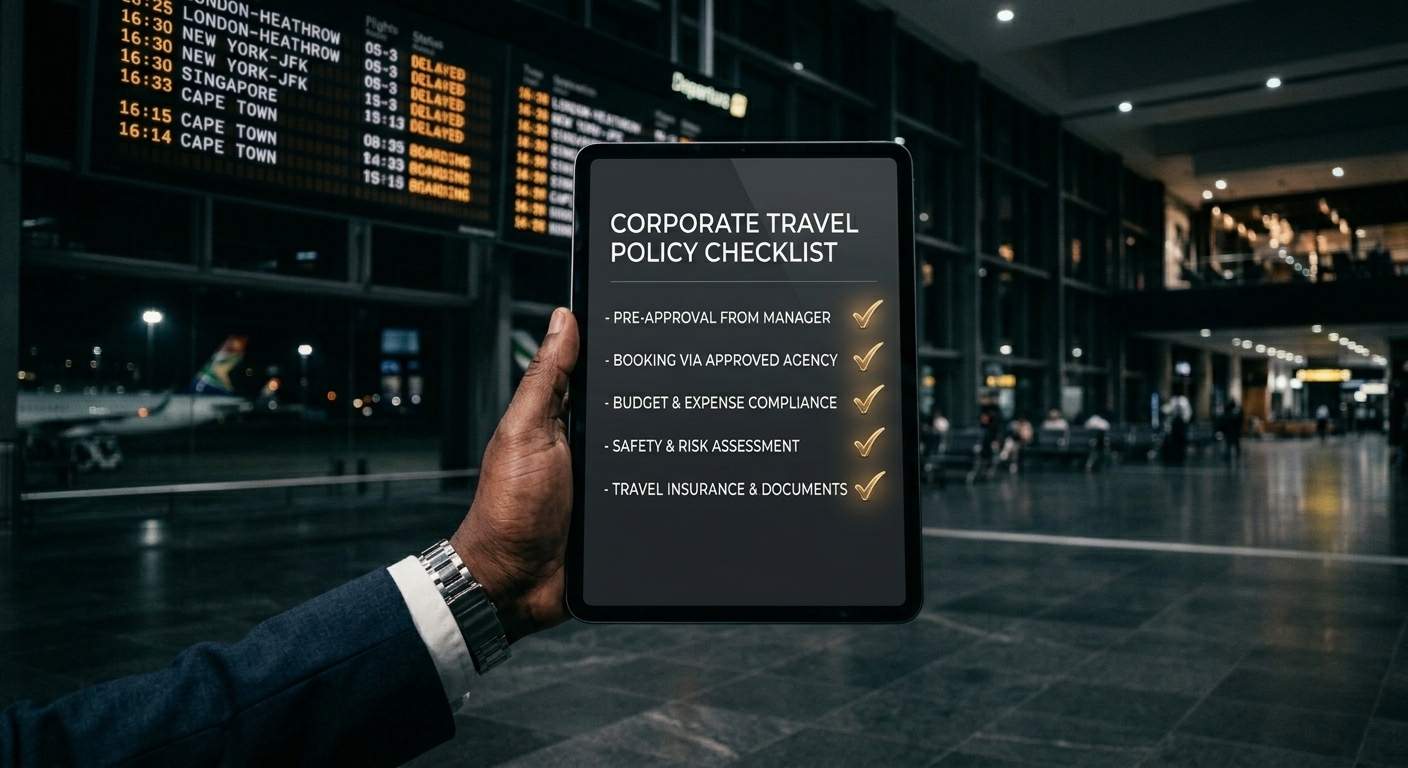
Advance booking minimum (14 days domestic, 21 days international)
At minimum: advance booking requirements, flight class guidelines, accommodation price caps by city, ground transport rules, meal and per diem allowances, an approval workflow, and an emergency contact procedure linked to your duty of care obligations.
How do I enforce a corporate travel policy?
The most effective enforcement mechanism is integrating your policy with your TMC's booking system. When an employee attempts to book outside of policy, the system automatically flags it for approval or blocks the booking. This removes the need for managers to police individual bookings manually.
What is policy leakage in corporate travel?
Policy leakage occurs when employees book travel outside your approved channels or above your policy limits. Common causes include urgency, convenience, and lack of policy awareness. Leakage is one of the biggest sources of uncontrolled travel spend for South African companies.
How often should a corporate travel policy be reviewed?
At least annually, or whenever there is a significant change in your business structure, travel volumes, or supplier agreements. Your TMC can flag when market conditions warrant a policy review — for example, when airfare or hotel market rates shift significantly.
Is a corporate travel policy legally required in South Africa?
A formal travel policy is not explicitly mandated by law, but it is strongly recommended from a risk management and duty of care perspective. Without a documented policy, companies struggle to demonstrate they took reasonable steps to protect travelling employees under the Occupational Health and Safety Act.