Business travel is typically the second or third largest controllable operating expense for South African companies — yet most finance teams manage it without benchmarks, without a structured programme, and without the visibility to know whether they are getting value. This article gives CFOs and finance managers the reference points they need to assess their current spend and identify where the leakage is.
Why Benchmarking Your Travel Spend Matters
You cannot negotiate what you cannot measure. Without baseline benchmarks for your domestic and international travel costs, you have no way to know whether your current spend is competitive, whether your suppliers are pricing you fairly, or where your biggest opportunities for savings lie.
Companies that benchmark their travel spend and compare it against managed travel programmes consistently find two things: their actual per-trip cost is higher than they thought, and the gap between their current spend and what a managed programme would cost is significant.
Typical Corporate Travel Spend in South Africa
The following ranges reflect market rates for common corporate travel scenarios in South Africa. These figures assume standard booking lead times; last-minute bookings will exceed the upper end of these ranges significantly.
| Travel Element |
Typical Range |
With TMC Rates |
| Domestic flight (JHB–CPT return) |
R3,500 – R8,000+ |
R2,800 – R5,500 |
| Accommodation per night (major cities) |
R1,500 – R3,500 |
R1,100 – R2,500 |
| Car hire per day (standard) |
R700 – R1,800 |
R550 – R1,400 |
| Meals and incidentals per day |
R450 – R900 |
R400 – R700 (per diem) |
| International flight (JHB–London return) |
R18,000 – R55,000+ |
R15,000 – R42,000 |

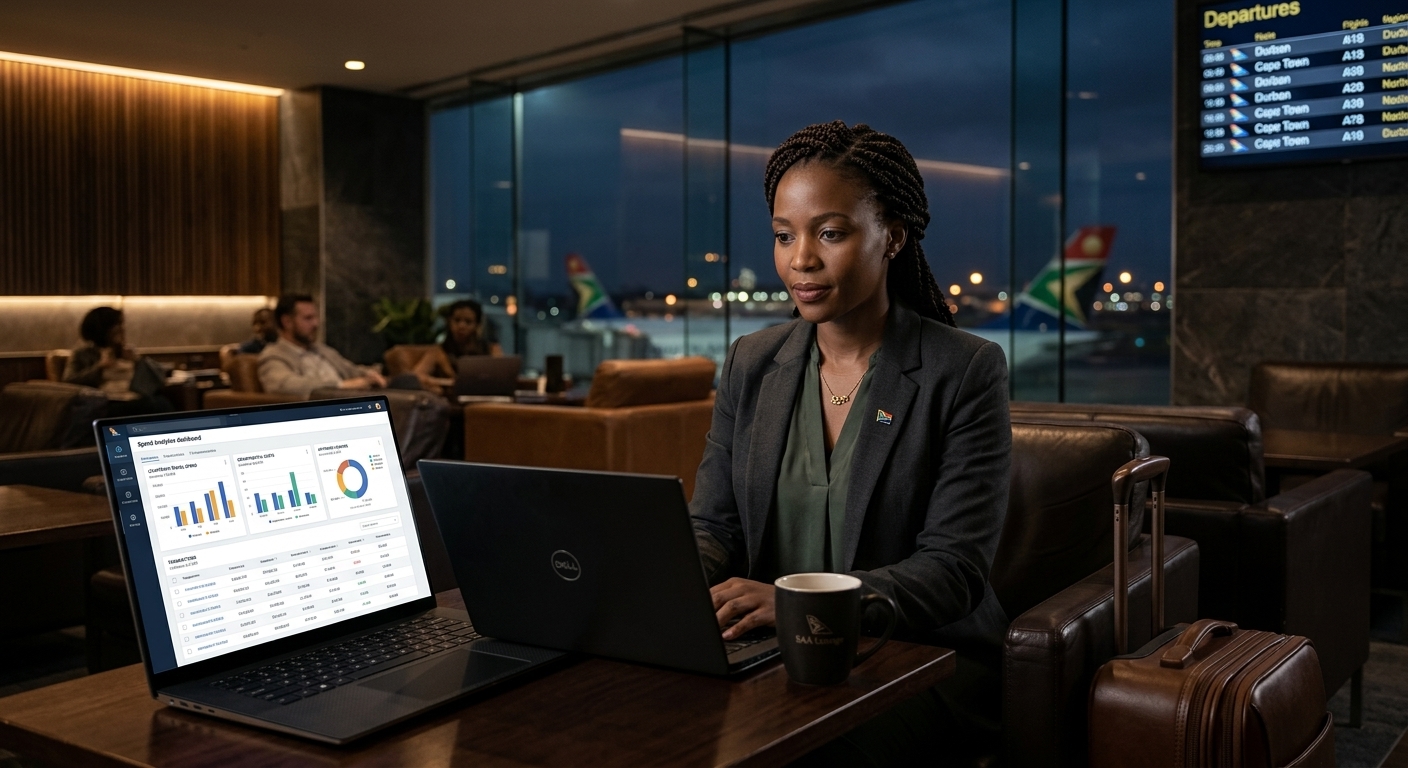
Centralised spend data through a TMC gives CFOs the visibility to negotiate, benchmark, and reduce travel costs.
The 5 Biggest Cost Drivers in South African Corporate Travel
Understanding where the money goes is the first step to controlling it. In our experience managing travel programmes for South African businesses, these five factors consistently drive the highest overspend:
1
Last-Minute Bookings
A domestic flight booked 24 hours before departure can cost 40–80% more than the same route booked two weeks earlier. Without a travel policy enforcing minimum advance booking windows, last-minute bookings become routine — and expensive.
2
Policy Leakage
Employees booking through personal apps, exceeding accommodation limits, or selecting premium options not covered by policy. Without a TMC enforcing policy at the point of booking, leakage is invisible — and compounds across a large team.
3
No Negotiated Rates
Consumer booking platforms charge retail prices. A TMC with preferred supplier relationships secures negotiated corporate rates on airlines, hotels, and car hire — rates that are typically not available to individual bookers regardless of spend volume.
4
Fragmented Booking Channels
When employees use multiple platforms — Expedia, FlightSite, direct airline websites, walk-in travel agents — the finance team has no consolidated view of total spend. No visibility means no leverage, and no leverage means no savings.
5
Hidden Ancillary Fees
Seat selection fees, checked luggage charges, cancellation penalties, and change fees all add up. Consolidated invoicing through a TMC surfaces these costs and allows your team to set policy around ancillary spend before it accumulates.
How a TMC Delivers 15–20% Annual Savings
Companies that implement a managed travel programme through a TMC consistently achieve 15–20% reduction in total travel spend within the first year. The savings come from multiple compounding levers:
- →Advance booking discipline. Policy enforcement prevents last-minute bookings, eliminating the largest single cost driver.
- →Negotiated rates. RTM Travel's preferred supplier relationships deliver rates below public retail prices on the routes and properties our clients use most.
- →Policy enforcement at booking. Out-of-policy requests are flagged before they are confirmed, eliminating exception-creep over time.
- →Consolidated invoicing. A single monthly invoice eliminates the administrative cost of reconciling multiple expense claims and catches ancillary charges before they are missed.
- →Spend data for negotiation. Knowing your total annual spend on a particular airline or hotel chain gives your TMC the leverage to negotiate better rates on your behalf.
A simple way to estimate your current overspend
Take your last 12 months of total travel spend. If more than 30% of your bookings were made within 7 days of travel, apply a 40% premium to that portion of spend. That premium — the gap between what you paid and what an advance booking would have cost — is a conservative estimate of your preventable last-minute booking premium alone.
Getting control of your travel budget starts with visibility. If your finance team cannot pull a consolidated spend report by trip type, destination, or employee, you are flying blind. Read our guide on writing a corporate travel policy that sets the cost controls your business needs, or speak to the RTM Travel team about what a managed programme would look like for your organisation.
Frequently Asked Questions
What percentage of revenue do South African companies spend on business travel?
Business travel typically represents 1% to 3% of total company revenue for South African businesses, making it one of the largest controllable operating expenses. The exact figure varies by industry — professional services, mining, and financial services companies tend to travel more intensively than others.
How can I reduce corporate travel costs without cutting travel?
Implement advance booking windows (domestic at least 14 days ahead), negotiate preferred rates through a TMC, enforce your travel policy at the point of booking, and consolidate all bookings through a single channel to gain spend visibility. Companies that do this typically achieve 15–20% annual savings without reducing travel volume.
What is the most expensive type of corporate travel in South Africa?
Last-minute bookings. A domestic Johannesburg–Cape Town flight booked 24 hours in advance can cost 40–80% more than the same route booked two weeks earlier. Policy leakage — employees booking outside approved channels and price limits — is the second-largest cost driver.
What does a typical corporate travel budget include?
Flights (domestic and international), accommodation, ground transport (car hire, ride-hailing, airport transfers), meals and per diems, visa and passport fees, travel insurance, and an emergency contingency allowance. Many South African companies underestimate the ancillary costs beyond the core flight and hotel booking.
How do I measure ROI on corporate travel?
Track which trips are tied to a deal, project, or business outcome, and measure the ratio of travel cost to business value generated over time. Your TMC can provide spend data segmented by trip purpose, destination, and employee to support this analysis.