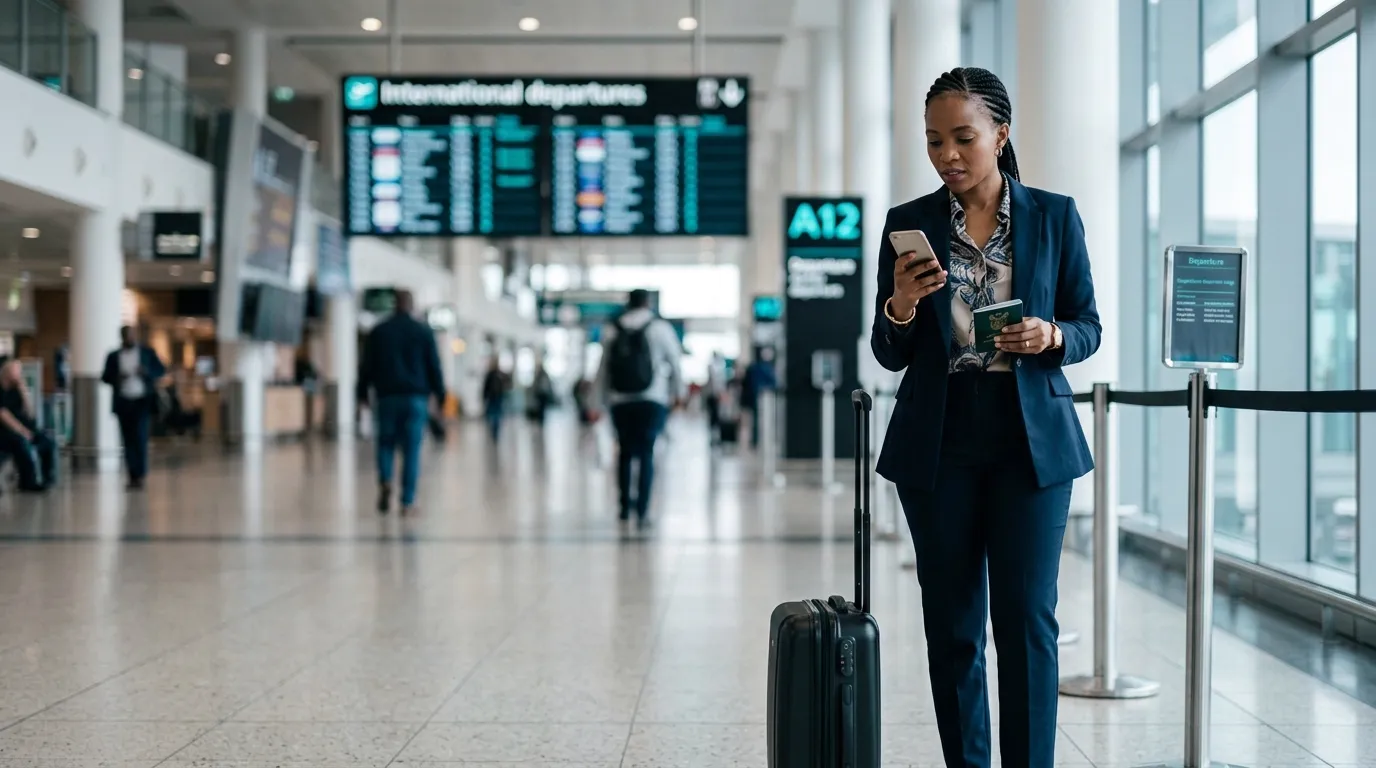
Since 1 July 2026, every person entering or leaving South Africa through an air, land, sea or rail port of entry must submit an online traveller declaration before they travel. This is no longer a nice-to-have or a pilot. It is a legal requirement, and it applies to South African citizens, residents and foreign nationals alike.
For companies that move people across borders regularly, this changes your pre-trip process. Not dramatically, but enough that a travel policy written in 2024 is now out of date.
Here is the short version, then the detail that actually affects corporate travel programmes.
Quick answer: what changed on 1 July 2026?
Every traveller crossing a South African border must now submit a declaration online, in advance, through the South African Traveller Management System (SATMS). The declaration confirms what goods, currency and other declarable items a traveller is carrying. It must be submitted no more than 24 hours before departure. Each traveller needs their own declaration, including children and infants. Paper declarations are now the exception, not the default.
Who has to declare
In practice, almost everyone.
Any person entering or leaving South Africa by air, land, sea or rail must submit a declaration. That includes South African citizens, permanent residents and visiting foreign nationals.
There is one meaningful exclusion. Air or sea travellers who are only transiting through South Africa and who do not leave the designated transit area do not need to submit a declaration.
Children and infants are not exempt. A parent or legal guardian must complete a declaration on their behalf. The same applies where a caretaker submits on behalf of someone who cannot do it themselves due to age, ill health or disability. Whoever completes the form carries responsibility for the accuracy of what is submitted.
The 24-hour window is the part that catches people out
This is the detail most travel policies will need to be rewritten around.
The declaration must be submitted no more than 24 hours before departure from the country you are travelling from. If your traveller is routing through a hub, the clock runs off the final leg directly into South Africa.
You cannot get ahead of this. A booking made six weeks out does not let you file the declaration six weeks out. Somebody has to do it inside a one-day window, usually while your traveller is packing, finishing a client meeting, or already sitting in a departures lounge in Nairobi.
For a company sending three or four people abroad in a week, that is three or four separate reminders that have to land at exactly the right moment. Miss it and your traveller is standing at a self-service terminal at OR Tambo doing admin they should have finished at home.
What your traveller needs to complete it
SARS asks for:
- →Passport or travel document details
- →Travel details (route, dates, port of entry or exit)
- →Contact details, including a valid email address for the confirmation
- →Details of any travelling companions
- →Entity details, where the person is travelling in a business capacity
That last point matters. Business travellers must indicate that they are travelling for business. If they are carrying commercial goods, further customs requirements may apply.
Where corporate travel gets complicated: goods and equipment
This is where a business trip stops looking like a holiday.
Ordinary personal effects do not need to be declared. A suitcase of clothes and a personal phone are fine.
Goods above the allowance do. The duty-free position, per person, is:
| Value of Goods |
Treatment |
| Up to R5 000 |
No duty or VAT |
| R5 000 to R25 000 |
Additional goods up to R20 000 may be allowed, subject to duty and VAT |
| Above R25 000 |
Normal customs duties and VAT apply |
The allowance applies once per person in any 30-day period, and it does not apply to someone returning after an absence of less than 48 hours. Allowances cannot be pooled or transferred between travellers, so two colleagues cannot combine theirs to cover one expensive item.
Commercial goods are treated differently. SARS defines these as goods brought in or taken out for trade, sale, business use or another commercial purpose. Goods can also be treated as commercial based on their nature, quantity or volume. A box of branded product samples for a trade show is a commercial consignment, not a personal effect, whatever the value on the invoice.
Equipment going out and coming back needs registering. Laptops, cameras, testing equipment, demo units and toolkits leaving South Africa and returning should be handled through the temporary export and re-importation process at the customs office on departure. Doing this properly on the way out is what prevents an argument about duty on the way back.
Cash and currency limits
Travellers may carry a maximum of R100 000 into or out of South Africa in local or foreign currency, or in bearer negotiable instruments, without prior approval.
Anything above the applicable legal threshold must be declared, and the system may ask for the currency type, the amount, the Rand value and the source of the funds.
If your finance team still issues cash advances for certain trips, this is worth a policy review.
How to submit the declaration
There are several channels, all free:
- The SARS Traveller Management System portal on the SARS website (sars.gov.za/travellerdeclaration)
- The SATMS mobile app, available from the Apple, Google and Huawei stores
- The SARS MobiApp
- Scan-to-Declare QR codes at ports of entry
- Self-service kiosks, where available at the port
After submission, SARS emails a confirmation containing instructions for what the traveller must do at the port. That confirmation should be saved to the phone or printed and kept accessible. If any details change before the traveller reaches the customs channel, the declaration must be updated so the record stays accurate.
What happens if someone does not declare
Two things are true at once here, and both matter.
First, no traveller will be denied entry into or departure from South Africa purely because they did not declare in advance. SARS officials and self-service terminals are there to assist people who could not submit beforehand. Paper declarations remain available in limited circumstances, specifically a SARS system failure, no internet connectivity at the port, or where a traveller is genuinely unable to submit electronically.
Second, the legal obligation to make a true and complete declaration has not softened. Failing to declare goods, currency or other relevant items, or submitting a false declaration, can lead to delays, detention or forfeiture of goods, penalties, and other enforcement action under customs legislation.
So the practical risk is not being turned away at the border. The practical risk is a senior person missing a connection because they are queuing at a terminal, or a piece of company equipment being held while its status gets resolved.
Two other changes worth knowing about
Foreign registered vehicles. From 1 June 2026, the declaration of foreign registered vehicles used by travellers moved onto the modernised process. Relevant for anyone running cross-border road travel into SADC markets.
Carnets are unaffected. The traveller declaration system does not replace the carnet process, which continues as a separate manual customs declaration. Vehicles under carnet do not need to be declared on the online platform, though the driver must still declare any other goods not covered by the carnet.
VAT refunds still work. Foreign visitors claiming a VAT refund should declare the relevant goods through the system, present themselves to customs for verification, and then finalise the claim at the VAT Refund Administrator office.
What South African companies should do this month
A short, practical list:
-
1.
Update your travel policy: Add the declaration as a required pre-departure step, with the 24-hour rule stated explicitly.
-
2.
Build the reminder into your booking process: The declaration cannot be done early, so the prompt has to fire at the right moment, not at the point of booking.
-
3.
Decide who is responsible: The traveller submits it, but somebody needs to confirm it was done. Make that an owned task rather than an assumption.
-
4.
Brief the people who carry equipment: Technical teams, sales teams with demo stock and anyone attending a trade show need the goods and re-importation conversation before they leave.
-
5.
Review cash advances: Check advances against the R100 000 threshold.
-
6.
Tell your travellers to keep the confirmation on their phone: It contains the instructions they need at the port.
Frequently asked questions
Do I need a SARS traveller declaration for a domestic flight?
No. The requirement applies only to travel entering or leaving South Africa across an international border, whether by air, land, sea or rail.
How far in advance can I submit my SARS traveller declaration?
No more than 24 hours before departure from the country you are travelling from. On a journey with stops, the window runs off the last leg directly into South Africa.
Does every employee on a business trip need their own declaration?
Yes. Declarations are per person and cannot be combined. This includes children and infants travelling with staff on relocation or extended assignment.
Do I have to declare my work laptop?
Ordinary personal effects do not need declaring, but company equipment leaving South Africa and returning should be registered for re-importation at the customs office on departure. That registration is what protects you from a duty assessment when it comes back.
What if there is no internet at the border post?
A paper declaration may still be used where there is a SARS system failure, where there is no connectivity at the place of entry or exit, or where a traveller is otherwise reasonably unable to submit electronically.
Will my traveller be refused entry if they forgot to declare?
No. Travellers will not be denied entry or departure solely for not having declared in advance. Customs officials and self-service terminals are available to assist. The declaration obligation itself still stands, and non-declaration or false declaration carries penalties.
Is there a cost to submit the declaration?
No. The SATMS portal, the mobile apps and the QR code channels are free to use.
Where RTM fits
Compliance steps like this one are exactly the sort of thing that quietly lands on an EA or a finance manager who already has a full job.
RTM Travel manages corporate travel for South African companies, which means the booking, the approvals, the traveller support and the pre-trip detail that keeps people moving. We have been doing it since 2008, we are ASATA and IATA accredited, and our travellers have someone to call at any hour.
If your travel policy has not been updated since 1 July, we can help you get it current.
Get in touch: Contact us on WhatsApp | rtmtravel.co.za
This article summarises publicly available SARS guidance as at July 2026 and is provided for general information. For binding guidance, refer to the SARS Customs Online Traveller Declaration page and the associated external policies, or contact SARS directly.